How do you use AI in marketing without flooding the market with obvious slop?
Put it behind the work nobody sees: campaign analysis across channels that report differently, asset versioning for every format a retailer demands, brief and research synthesis, and performance attribution. Generation is the smallest part and the easiest for a competitor to match, because they bought the same tool. Anything customer-facing goes through a human who is accountable for it.
Marketing & Creative AI
The part everyone buys first is the least valuable
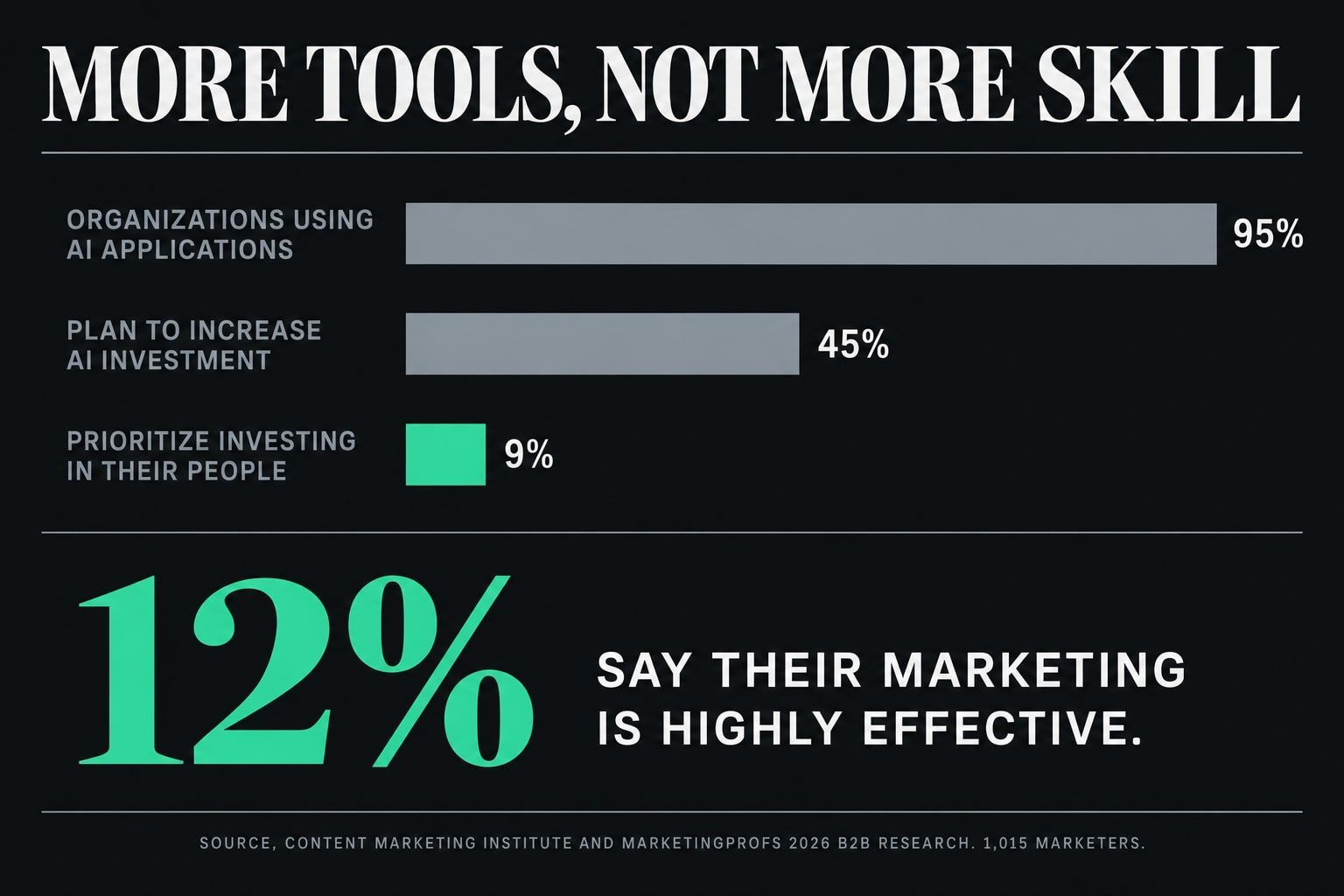
Marketing is where most AI budget lands and where the least of it returns, because the offer is almost always generation. More content faster is not the constraint in any marketing team we have met, and your competitor bought the same tool last quarter.
The constraint is usually that nobody can say what worked, and that getting one approved creative into forty required formats takes two weeks.
What we build
Performance consolidated across channels that each report differently and each claim the same conversion. The output is one method applied consistently, with the assumptions written down, rather than a dashboard that flatters whoever built it.
Asset versioning at scale: sizes, formats, localizations, and retailer specifications generated from one approved master, with the rules encoded. This is structured work with a clear right answer, which is exactly what machines do well and people resent doing.
Research and brief synthesis before a campaign is scoped, so the planning starts from what is known rather than from what someone remembered.
Generation, yes, with a written voice standard, a named reviewer, and the model held against your own best work.
The review gate
Anything customer-facing has a person accountable for it by name. Not because the output is unreliable, though sometimes it is, but because a brand is a promise and a machine cannot be accountable for keeping one.
What you get
- Campaign and channel performance consolidated across platforms that report differently
- Asset versioning: one approved creative resized, reformatted, and localized for every channel and retailer spec
- Brief, research, and competitive synthesis assembled before a campaign is scoped
- Content generation with a named reviewer and a brand-voice standard the model is held to
- Attribution and incrementality analysis that a CFO will accept
Questions we get
- Will this make our marketing sound like everyone else's?
- It will if you let it, and most tools do exactly that. The defence is a written voice standard with banned constructions, a named reviewer, and generation held against examples of your own best work rather than a generic prompt. We build the standard first; the generation is downstream of it.
- What is the highest-return thing here?
- Usually asset versioning. One approved creative has to become forty sizes, formats, and retailer specifications, and that work is currently manual, late, and the reason campaigns slip. It is also structured, rule-bound, and safe to automate.
- Can you prove marketing spend worked?
- We can improve the argument. Attribution across channels that each claim the same conversion is a modelling problem with real uncertainty, and anyone promising certainty is selling. What we build is a consistent method, applied the same way each period, with the assumptions written down.
How it starts
Two-week audit of where marketing hours go, then four to eight weeks per workstream. You keep everything produced, whether or not there is a next part.